10×10 vs 15×15 vs 20×20 Nonograms: What Actually Changes With Size
A 20 × 20 nonogram has four times the cells of a 10 × 10 — but it is not simply four times the work. We measured 1,140 random puzzles from our generator to see what grows, and how fast.
Short answer: going from 10 × 10 to 15 × 15 roughly doubles the work (43 → 91 line deductions on average), and 20 × 20 takes 157 — 3.7 times a 10 × 10. The clues get longer too: 2.8 numbers per line at 10 × 10, 4.0 at 15 × 15, 5.2 at 20 × 20. Each line also has to be revisited more often: 2.2 deductions per line at 10 × 10, 3.9 at 20 × 20.
How we measured
We took the generator behind the random puzzles on this site — each cell filled with a probability of 0.58, then kept only if a line-by-line solver finishes it — and produced 300 puzzles each at 5 × 5, 10 × 10 and 15 × 15 and 120 each at 20 × 20 and 25 × 25 (seeds 1000 upwards; 1,140 puzzles). For each puzzle we counted the numbers in every clue and ran the solver's Next step until the grid was complete. A "line deduction" is one row or column that gives at least one new cell: roughly the number of times a solver has to stop, read a clue and conclude something.
| Size | Cells | Numbers per clue (avg) | Most numbers in one clue | Line deductions to solve (avg) | Deductions per line | Random grids passing the check |
|---|---|---|---|---|---|---|
| 5 × 5 | 25 | 1.6 | 3 | 13 | 1.3 | 83.6% |
| 10 × 10 | 100 | 2.8 | 5 | 43 | 2.2 | 79.6% |
| 15 × 15 | 225 | 4.0 | 8 | 91 | 3.0 | 68.5% |
| 20 × 20 | 400 | 5.2 | 9 | 157 | 3.9 | 64.2% |
| 25 × 25 | 625 | 6.4 | 11 | 240 | 4.8 | 43.6% |
"Random grids passing the check" is the share of random grids that line logic could solve completely; the rest were thrown away and the generator tried again. All puzzles you play on this site are from the passing group.
10 × 10: one idea per line
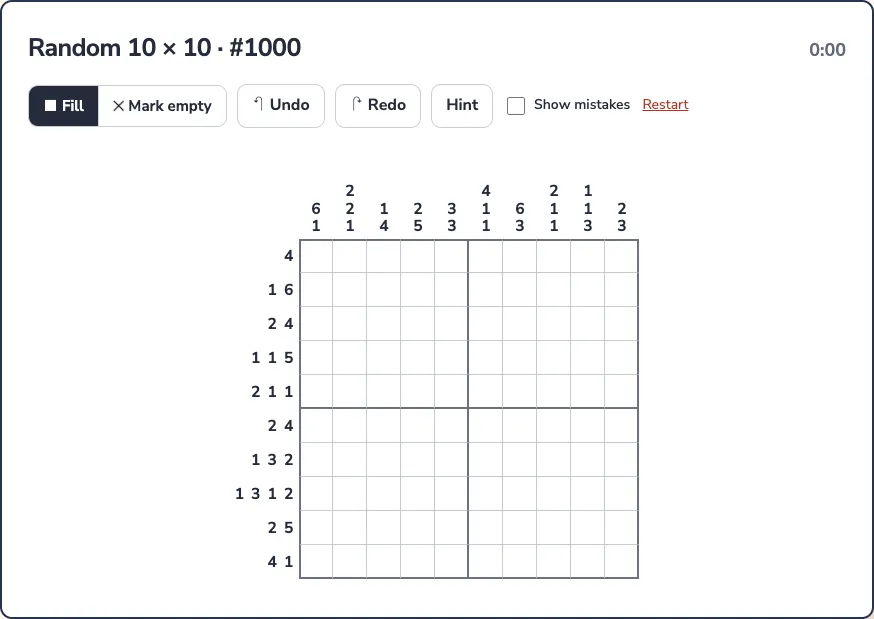
With under three numbers per clue, most 10 × 10 lines give their information in one or two looks. Big blocks are common — a 7 or 8 in a 10-cell line — so the overlap tip starts almost every puzzle. This is the size most picture puzzles use and the one to learn on after 5 × 5.
15 × 15: the jump in reading
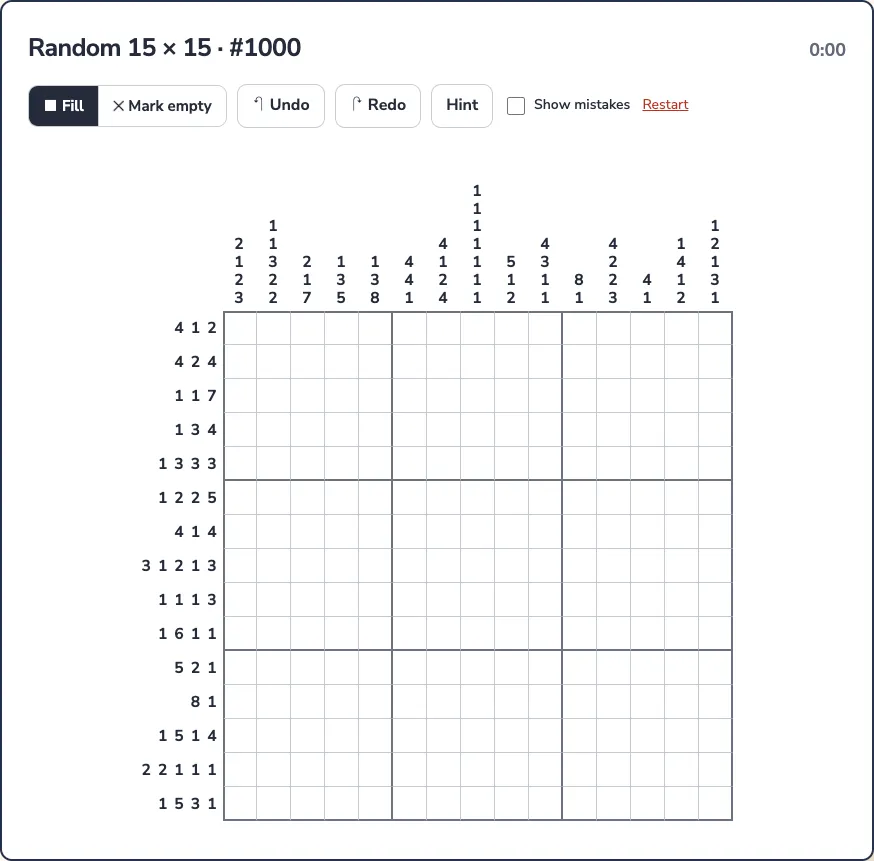
At 15 × 15 an average clue has four numbers and some have eight. The overlap still works, but on fewer lines: with many short blocks, the minimum length of a clue (blocks plus gaps) is further from the line length. Expect to come back to each line three times. It is also the size where marking empty cells (crosses) stops being optional — without them, it is hard to see which block a filled cell belongs to.
20 × 20 and up: a session, not a break
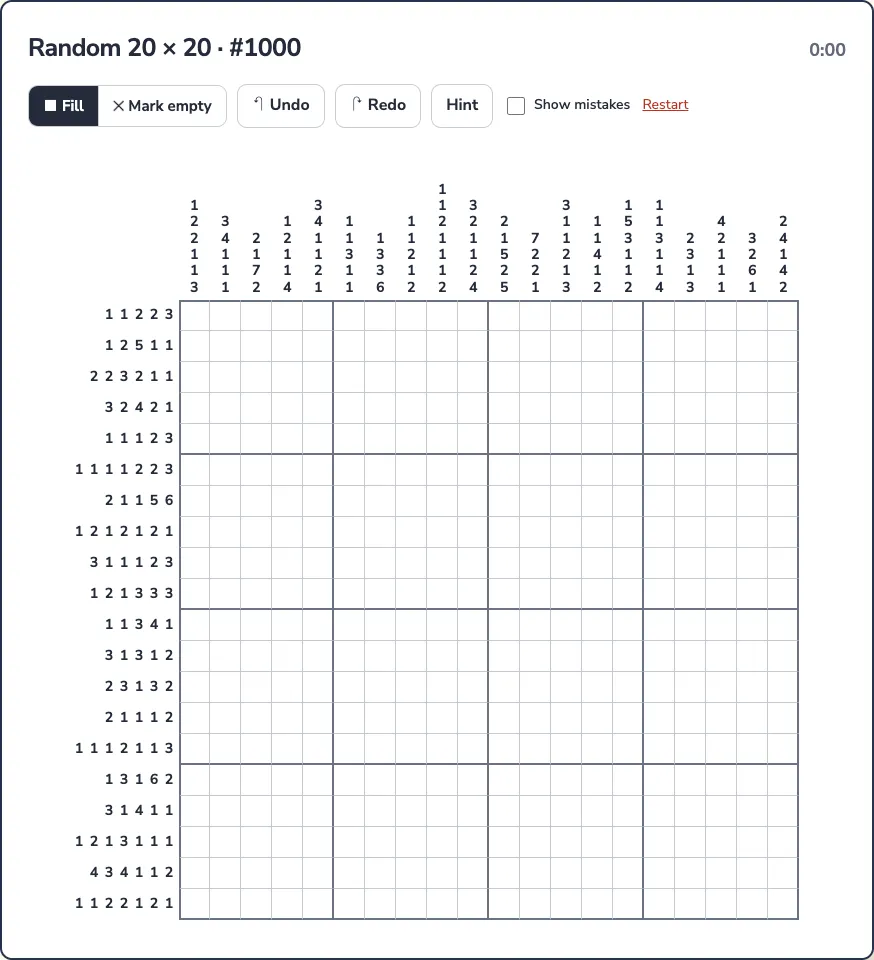
A 20 × 20 needs about 157 deductions and 25 × 25 about 240. Clues of 9 to 11 numbers appear. Two practical things change: you need more screen space (cells shrink as the grid grows, so a tablet or computer is easier), and keeping track becomes the main difficulty. Work in bands of five rows or columns — the thick grid lines mark them — and finish the edges early, because edge cells act as walls for everything else.
Why bigger random grids fail more often
At 5 × 5, 83.6% of random grids pass the line-logic check; at 25 × 25 only 43.6% do. A bigger grid simply has more places where a small ambiguous patch can appear — two cells that could swap, or a corner that needs a trial step. That is also why puzzles drawn by hand, or turned from a photo in the maker, fail the check more often at larger sizes. When line logic is not enough shows what such a patch looks like.
Which size to choose
| You want… | Choose |
|---|---|
| To learn the rules | 5 × 5 (13 deductions); print a sheet of six |
| A coffee break | 10 × 10 — the daily 10 × 10 or a picture puzzle |
| A real challenge on a phone | 15 × 15 |
| A long session | 20 × 20 or 25 × 25 on a larger screen, or printed one per page |
For paper, the printable sheets fit two 15 × 15 or one 20 × 20 per page with readable cells. Every puzzle in this article can be reopened with its link: the seed in the address always gives the same grid.
Sources
- Puzzle statistics: Nonogram Lab measurement, run on this site's own solver and generator (Node.js, 15 November 2026). Method described in the article (1,140 generated puzzles, seeds 1000 and up)