Nonogram Solving Tips for Beginners (With a Free PDF Cheat Sheet)
Six moves solve almost every beginner nonogram. Here each one is shown on a real 10 × 10 puzzle, using the step-by-step view of our solver, and all six fit on a one-page PDF you can print.
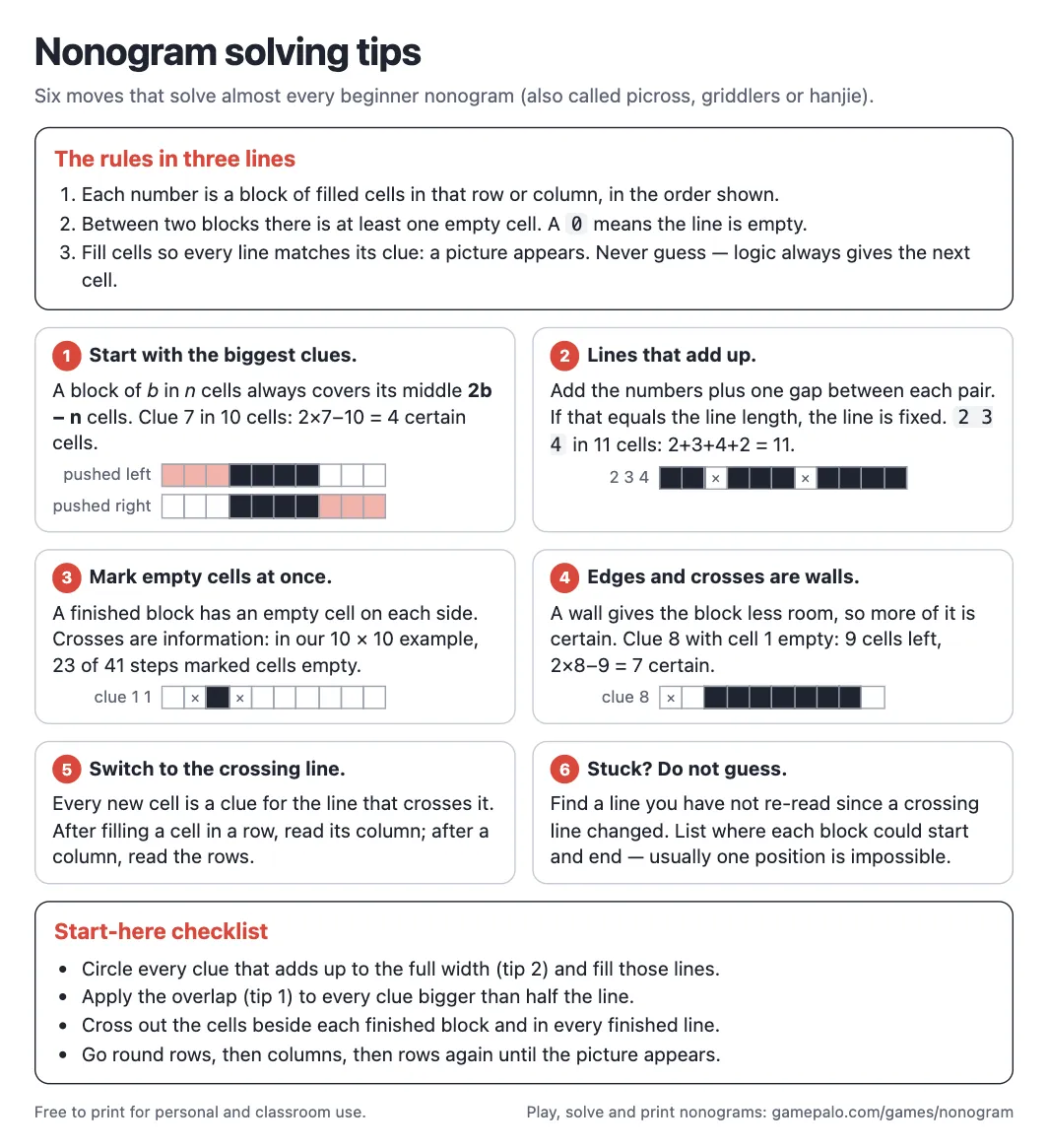
The six tips: (1) start with the biggest clues — a block of b cells in a line of n always covers its middle 2b − n cells; (2) fill lines whose clues add up to the full width; (3) mark a cell empty as soon as you know it; (4) treat the edge and known empty cells as walls; (5) after every new cell, look at the crossing line; (6) never guess — when stuck, revisit lines whose crossing lines have changed.
Download the cheat sheet (PDF, 1 page) — US Letter, prints on A4 too.
The cheat sheet
The PDF has the rules in three lines, the overlap formula with a worked row, the six tips with tiny diagrams and a start-here checklist. It is free to print for personal and classroom use. Put it next to a sheet of six 5 × 5 puzzles for a first session; the 5 × 5 size is small enough that every tip shows up within a minute or two.
The practice puzzle
All examples below come from one puzzle: the 10 × 10 "Duck" from our picture puzzles. Its row clues, top to bottom, are 3 · 5 · 2 2 · 6 · 4 · 4 1 · 8 · 10 · 8 · 6. Loaded into the nonogram solver, the Next step button settles one row or column at a time and says why. The Duck takes 41 such steps, and no step needs a guess. Rows and columns are numbered from the top and from the left.
Tip 1: start with the biggest clues
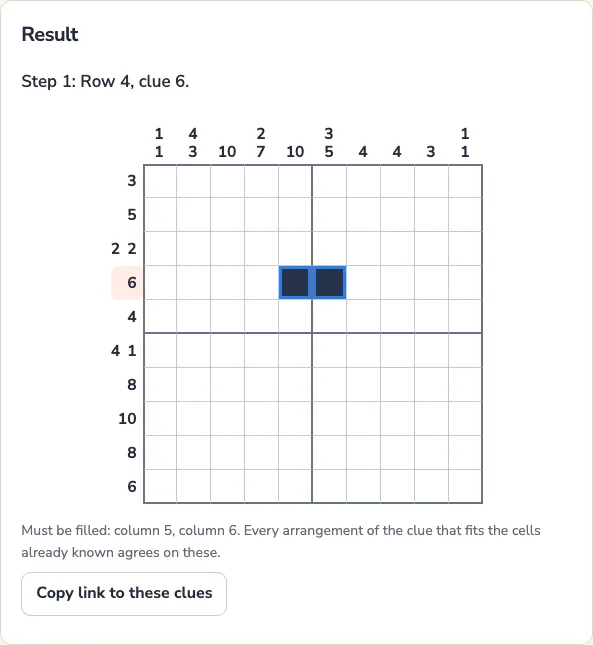
A block of 6 in a row of 10 can start anywhere from cell 1 to cell 5. Pushed left it covers cells 1–6; pushed right it covers 5–10. Cells 5 and 6 are covered either way, so they must be filled. In general a block of b in n cells has 2b − n certain cells when b is more than half of n.
That is exactly the solver's first step on the Duck: row 4, clue 6, fills cells 5 and 6 (2 × 6 − 10 = 2). Step 2 is row 7, clue 8: 2 × 8 − 10 = 6 cells, so cells 3 to 8.
Tip 2: lines that add up to the width
Add the numbers and one gap between each pair. If the total equals the line length, there is only one way to place the blocks. The Duck has three such lines: row 8 (clue 10) and columns 3 and 5 (both 10). The solver fills row 8 at step 3. Clues like 4 5 in 10 cells (4 + 5 + 1 = 10) or 2 2 5 in 11 cells work the same way, and they are the best place to start any puzzle.
Tip 3: mark empty cells straight away
Step 6 is column 1, clue 1 1. Row 8 is full, so column 1 already has a filled cell in row 8. That cell is one of the two 1s, and a block of 1 cannot touch another filled cell — so rows 7 and 9 of column 1 must be empty. Nothing is filled in this step; it only marks two crosses.
Those crosses matter: of the Duck's 41 steps, 16 only mark cells empty and another 7 mark some cells empty while filling others. If you do not mark empty cells, you lose the information those 23 steps provide, and the very next step depends on it.
Tip 4: walls make blocks shorter
Step 7 goes back to row 7 (clue 8). With column 1 now empty, the block can only move within cells 2–10, nine cells. The overlap becomes 2 × 8 − 9 = 7 cells: 3 to 9. Cell 9 is new. Step 8 does the same for row 9. A known empty cell, like the edge of the grid, is a wall: the block has less room, so more of it is certain.
Tip 5: switch to the crossing line
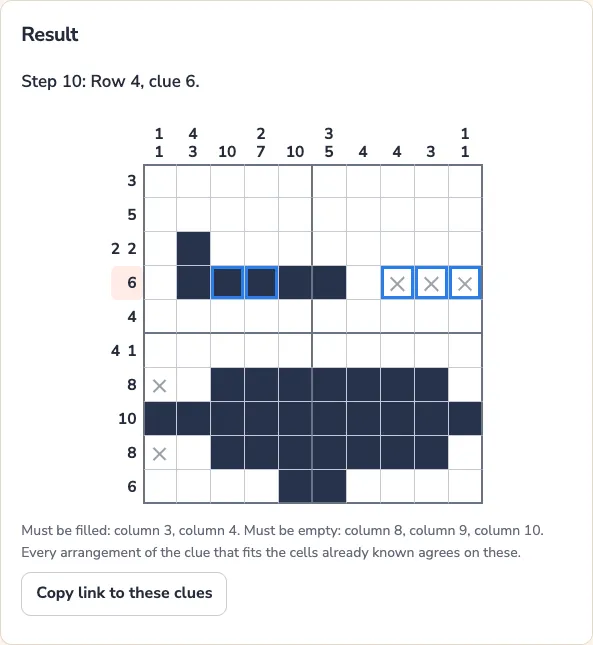
Every new cell is information for the line that crosses it. At step 9 the solver turns to column 2, clue 4 3, with row 8 known to be filled. Pushed as far up as possible the blocks sit in rows 1–4 and 6–8; pushed down, in rows 3–6 and 8–10. The 4 is in rows 3–4 both times, so they are filled.
Step 10 then returns to row 4 (clue 6), which now has cells 2, 5 and 6 filled. One block of 6 has to cover all three, so it starts at cell 1 or 2: cells 3 and 4 are filled, and cells 8, 9 and 10 are out of reach and therefore empty.
Tip 6: never guess
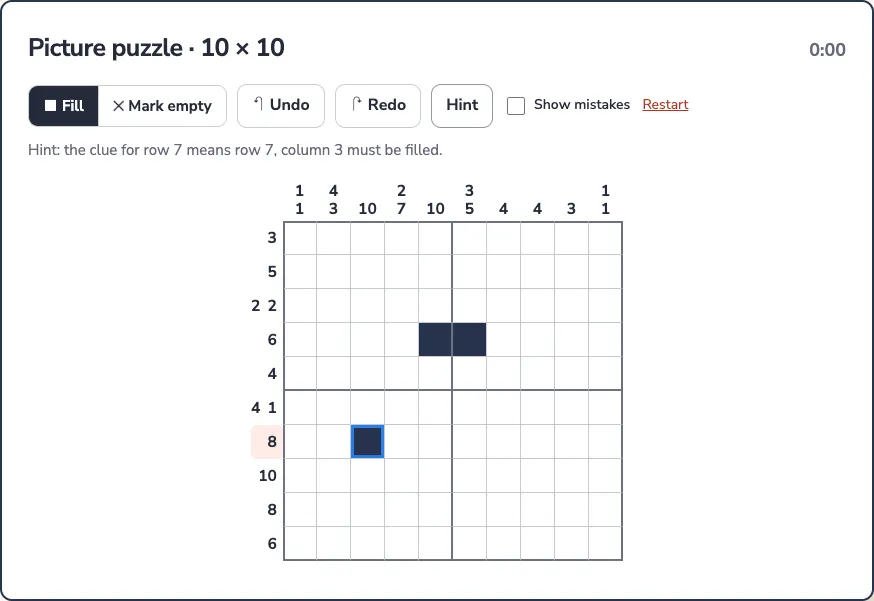
A well-made nonogram never needs a guess, and all puzzles on this site are checked for that. When you feel stuck, a deduction has been missed: look for a line you have not re-read since one of its crossing lines changed. In the game, the Hint button does exactly this. It first points out a wrong cell if there is one, then fills the next cell that follows logically and highlights the clue that proves it.
Some puzzles from other sources genuinely cannot be solved one line at a time. That is a different skill, shown in when line logic is not enough.
A first session
- Print the cheat sheet and a sheet of 5 × 5 puzzles with its answer page.
- For each puzzle, circle the clues that add up to 5 (tip 2) and fill those lines first.
- Then try the Duck on screen. If you get stuck, press Hint once and read the message before continuing.
- When the Duck goes smoothly, move on to a daily 10 × 10.
Sources
- Step data: Nonogram Lab measurement, run on this site's own solver and generator (Node.js, 15 November 2026). Method described in the article (the Duck puzzle in the solver, 41 steps)
- Rules and technique names: How to play nonograms on this site