Solving a Nonogram From a Screenshot: Type the Clues, Catch the Typos
Have a nonogram on a screenshot, a photo of a puzzle book or a newspaper page? The reliable way to solve it is to type its clues. We made 804 deliberate typing mistakes on our own puzzles to see which ones a solver catches.
Short answer: type the row clues top to bottom and the column clues left to right, one line each, numbers separated by spaces, and 0 for an empty line. Then press Solve. In our test, all 596 one-digit slips (a 4 typed as 3 or 5) were caught before solving, by the line-length and total checks. Order mistakes are the dangerous ones: of 149 pairs of neighbouring lines typed in swapped order, 139 gave "no solution", 1 gave two solutions and 9 gave a different picture that the solver accepted.
Copying the clues in two minutes
- Count the lines first. A 15 × 15 has 15 row clues and 15 column clues. The solver takes the grid size from the number of lines you type.
- Rows: read each row's numbers left to right and press Enter after each row.
- Columns: read each column's numbers top to bottom — on a screenshot they are stacked vertically — and press Enter after each column.
- Empty lines: type 0. Skipping them shifts every later line by one.
- Save it: Copy link to these clues puts the whole puzzle in a link, so you can come back without typing again.
The Duck from our picture puzzles has 27 clue numbers (12 in the rows, 15 in the columns). A 15 × 15 averages about 120. Each number has to be right, whether you type it or software reads it from an image — which is why the checks below matter. (We did not test image-reading solvers; the checks protect you either way.)
The test: 804 deliberate mistakes
We took the ten 10 × 10 picture puzzles from this site and made every mistake of three kinds, one at a time, then ran each changed set of clues through the solver's checks and search:
| Mistake | Cases | Caught before solving | "No solution" | "Two solutions" | Wrong picture accepted |
|---|---|---|---|---|---|
| One number off by 1 (5 → 4 or 6; a 1 typed as 0 drops the block) | 596 | 596 | 0 | 0 | 0 |
| Two numbers of one clue in swapped order (2 7 → 7 2) | 59 | 0 | 59 | 0 | 0 |
| Two neighbouring lines swapped | 149 | 0 | 139 | 1 | 9 |
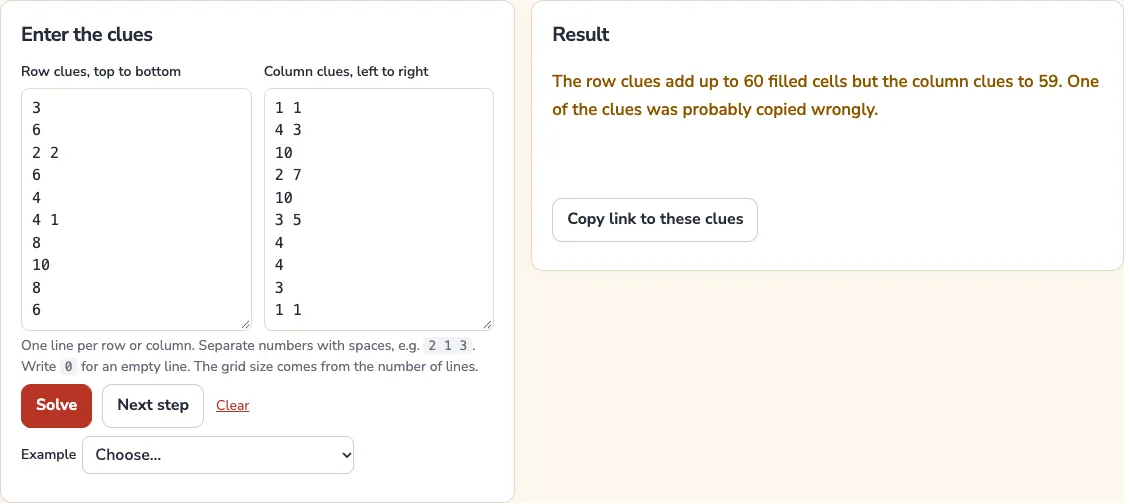
Of the 596 off-by-one slips, 544 made the row total differ from the column total and 52 made a clue too long for its line. Both are checked before any solving starts, so the solver names the problem instead of showing a wrong picture:
The sneaky mistakes: order
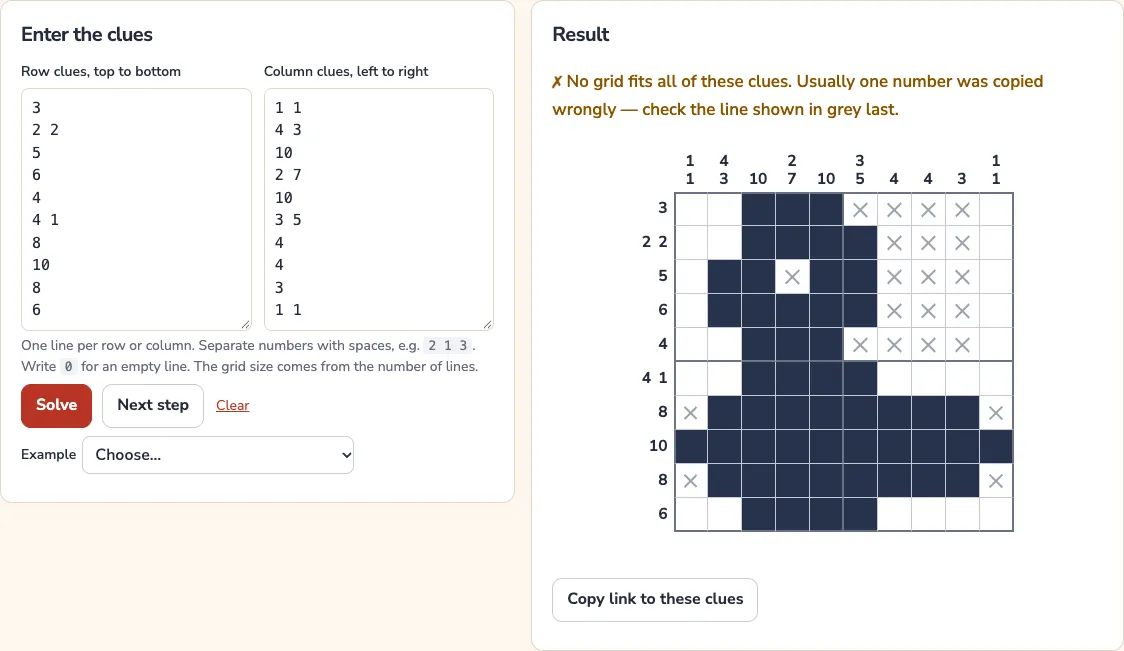
Swapping two numbers or two whole lines keeps every total the same, so no simple check can see it. Usually the clues then contradict each other and the solver says no grid fits. Here rows 2 and 3 of the Duck are swapped:
Nine times out of 149, though, the swapped clues described a different valid picture. All nine were line-solvable, so the solver reported success. With rows 5 and 6 of the Duck swapped, it draws a duck whose two rows changed places — a difference of two cells:
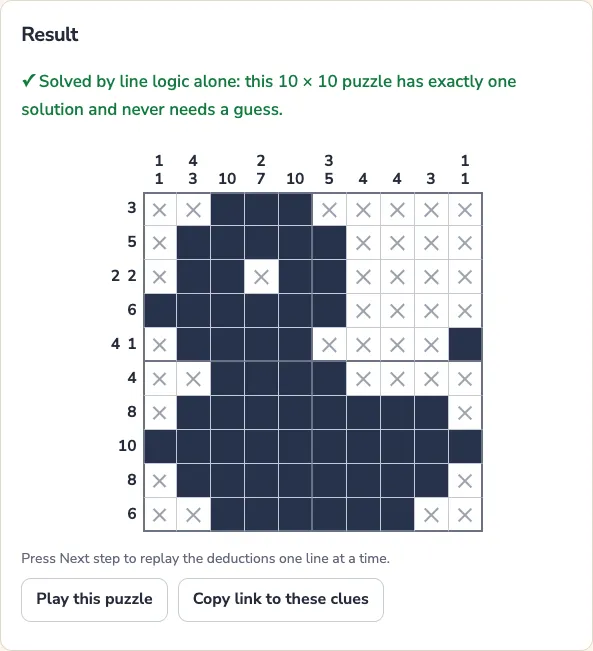
Swaps that survive are between lines with similar clues — in the Duck, rows 5 and 6 read 4 and 4 1. So after solving, compare a few rows of the picture with the source, especially wherever two neighbouring clues look similar.
When the solver says "no solution" or "two solutions"
- No solution: look for order mistakes first — two numbers swapped inside a clue, or two lines in the wrong order. Use Next step: the line where it reports a contradiction, or the last lines it changed, are where to look.
- Two solutions: a number may be missing or a line skipped. The outlined cells show where the two pictures differ. If the source puzzle is well made, it has one solution, so recheck the clues around the outline.
- One solution, but line logic stops: the clues are probably right and the puzzle is just hard. Here is how to solve those by hand.
A note on apps: some puzzle apps rank or time their players, and outside help may be against their rules in those modes. For books, newspapers and casual play, checking your work with a solver is the quickest way to find an error.
Sources
- Mistake test: Nonogram Lab measurement, run on this site's own solver and generator (Node.js, 15 November 2026). Method described in the article (the ten 10 × 10 picture puzzles on this site; every single change of each kind)